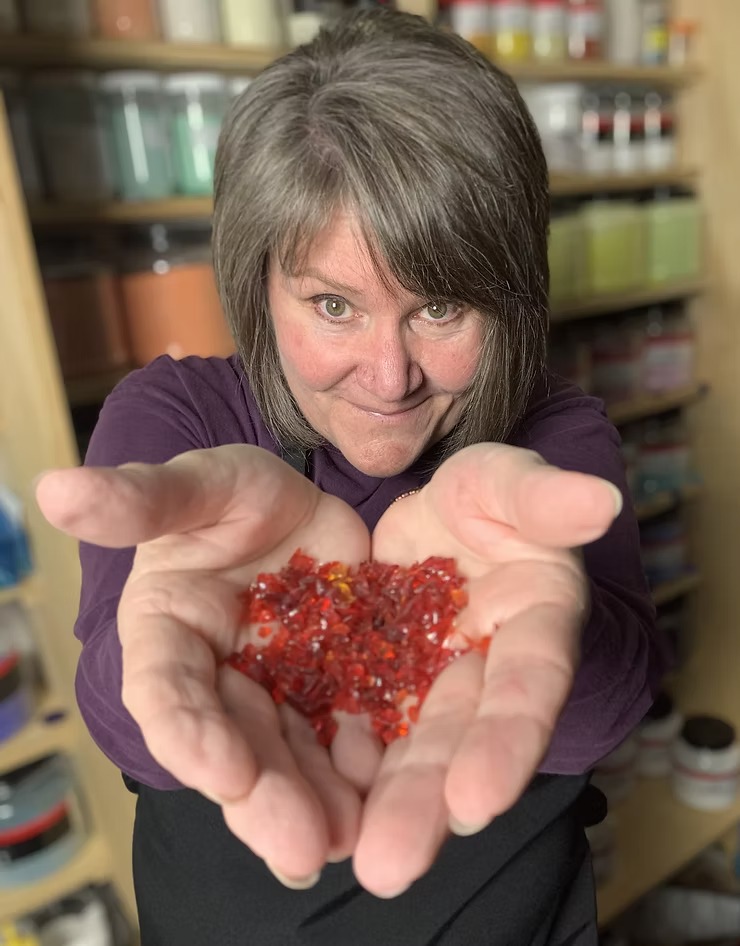
“It’s okay to change your mind. It’s okay to stay in bed today. It’s okay not to make art for six months… I’m too old to feel bad about stuff. And you [young people] shouldn’t either.”
-Deb Williams
Deb Williams: I guess this is my going on my ninth year. I’ve always been here with the Mark Bettis Gallery. There are a lot of people that have been here longer than me. It feels like I’ve seen some changes happen for sure since I’ve been here.
JM: What are some of those changes?
DW: When I first came into the gallery, I worked as a sales person. For me to sell a $10,000 painting was a common occurrence. We would have people fly up from Florida just to buy a painting from Mark, buy the painting, get back on the plane and leave, and then we’d ship the painting to them. Pre pandemic. And now…I don’t know. We’re getting a lot of bodies into the district, but not necessarily buyers. Having said that, we still have a lot of people supporting us. There are still buyers.
Mark [Bettis’] workspace was here when I first came. All of this was a big work table, and he was back there painting, so it was a working studio. People would come in and stand and watch him paint and talk with him while he painted. That lent a different air than this is just gallery space now. A lot of the working artists are doing that. Phil DeAngelo did the same thing. He’s taking his studio home. Michael Hoffman moved his big pottery studio home and they’ve turned their spaces into just gallery spaces.
JM: What brought you to Asheville and the River Arts District?
DW: Asheville was a weird one. My husband and I have moved around a few times. We came from Colorado. We went to Kentucky, we went to Oregon. We went to St. Louis, and back to Kentucky. I was looking for a place that has an artist community. In several of the places that we had lived, I tried to get into an artist community. But it was like tight little clubs – they didn’t really want new people coming in. We just found Asheville and we moved here without ever having even visited it. We just packed up and moved here. We just felt like it was the right place to be.. I’ve heard a lot of people say that. I’d never even seen it.
I was in an online art group. Most of them were painters actually, but I just joined because I liked the community, and when we got ready to move here, I knew that there were several people in the group from Asheville. So I reached out to all of them and said, would you just have coffee with me when we get there? We just want to know about the areas in the town. Where do you live? What do you like? What do you not like? Only one person answered me. She’s the sweetest thing. Wgot together and had coffee and there was like this instant connection. I needed friends. I needed a job, and I needed someplace to show my work. And she went, I’m gonna talk to Mark Bettis about you because I think you’d be a good fit. I had a meeting with him, he brought me in, and I’ve been here ever since.
JM: What is unique about the River Arts District?
DW: It’s the people and the community. That was strong before Hurricane Helene, but when Helene hit… It like jelled everybody together. We’re a much tighter group now than we were before. Even though we’re scattering, we’re still a tight knit group, and I think that’s amazing. The other thing is just the idea that somebody could come into town and in a mile space they could see 600 different artists, get food, have a beer, go to the record store, all these things. It’s amazing. Go walk along the walking trail.
JM: How has the hurricane impacted you and your work?
DW: My studio at home was fine. We had a little bit of damage in the yard, a couple of trees that were down the next morning. We knew that a storm was coming and we watched it rain and wind and all that the night before.
But when we got up in the morning and we went out, we thought this doesn’t look bad. Maybe it wasn’t as bad as they said it was gonna be. But when we were standing on the deck, I said, Frank, there’s no birds. We have tons of birds in our yard. And it was so quiet…
[Mark Bettis Gallery] was fine. We didn’t get any water in here to speak of, but down below – that’s the Wedge Brewery, and the record store. Their water was up to the ceilings, so at the bottom of our floor. We were so fortunate that we were on the top side of this.
When they were down there in the lower River Arts District digging in mud, pulling their paintings out and all of that stuff, Phil DeAngelo said, we need to be supporting them. How can we do that? We’ll feed them. So he turned two studios into a kitchen. We made meatball subs, we sent sandwiches, we sent drinks. So every Monday, Wednesday, and Friday, all the artists would gather here on the sidewalk and we would feed them, hug them. Body and soul. That’s what we said. It’s not just about the food. And really, it wasn’t just for the artists either. We had so many people that came in that were in need.
We had a couple that lived near here, but they couldn’t speak English. They came down every day to get food because they couldn’t, they didn’t have a car and they couldn’t get anywhere to get anything. So once a day we would just load ’em up with stuff and send it back home and they got a hot meal. There’s so many stories relating to that. I could talk for hours about that. It was a good experience for me too, because I felt like I could do something. I couldn’t physically be down in the mud for some health reasons, but I could do that.
But the downside of it is the economic part. Our biggest month is October. We lost all that income. So many artists are in the red because of that. They’re just in the hole and trying to hang on and hope that the next season is going to be good for us.
JM: How do you feel like Asheville, and being a part of the River Arts District, influenced you and your artwork?
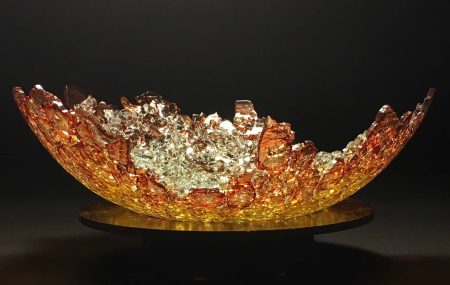
DW: It’s definitely advanced me in my skills. Encouraged me to challenge myself, to keep doing new and innovative things, different things that nobody else is doing so that I can be unique in the field of lots of artists. The glass community here is so warm and welcoming. Everybody is really supportive.
JM: Glass and metalworking are not exactly the most accessible mediums, how did you first get into those fields?
DW: I studied interior design. My husband always tells me that my brain works differently than a lot of people, but I see other artists whose brains work like mine. I went through several iterations of things… I was a sign language interpreter, other things. We lived out in the country in Oregon and I was bored being out there by myself, so I just wanted to take a class and I took a stained glass class. I didn’t love it at all. I just thought, this is not my thing. But one day when I was there in the studio, they were having a glass casting class.And they had all these buckets full of colored glass, red, blue, green, yellow, all these different things, and they were mixing and pouring and making molds. It was so amazing. I didn’t know anything about glass, and I thought, whatever it is you’re doing, I want to do that.
So I just started taking classes and then experimenting much on my own. Really, a lot of what I’ve learned has been by my own mistakes and experimentation for sure.
JM: How does your glasswork and your vegan taxidermy series speak to each other?
DW: Maybe it’s more in process. I’m a very tactile person. The mold making process is a very tactile, hands-on kind of thing. The taxidermy is very much as well. Yeah.
I love doing stuff with my hands.
JM: What inspires your art?
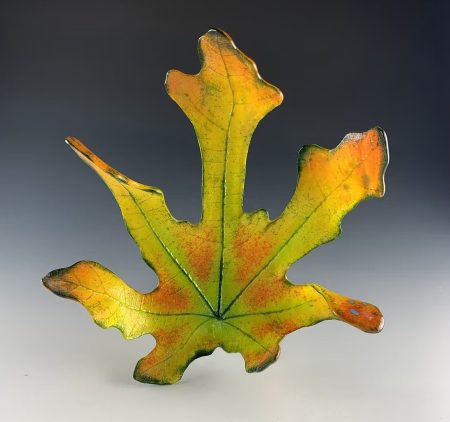
DW: It’s a cliche thing, isn’t it? For an artist to say, I’m inspired by nature, we all are. When I lived in Oregon, I lived along a river and there were these giant maple leaves, and I kept driving by those and thinking, how can I make that in glass? I was new in glass, so I didn’t know how I was gonna make this giant leaf. I just started playing with it and playing with it.. we’re on a search always.
I might do something different. I don’t know what that is yet. I’m at a crossroads with my process and thinking. What I need to do to challenge myself here.
JM: What is your artistic process like? How intuitive is it or planned out?
DW: I’m not one for sketching my ideas.. They’re all in my head and I pretty much know how I want that to be before I start it. The little tiny details might change a little bit. I can see it all in my head, and so I just work on it until it gels.
JM: So what’s next for you?
DW: I haven’t really been in the studio much since Helene. Now I’m just starting to get the pull to want to be back in the studio. Over the last couple months I’ve gone into the studio and went, I don’t really want to be in here. And that hurts me ’cause it’s like my sacred place. I just love being in there and having all my little things around me. That’s slowly coming back. I know the work’s gonna be different. I’m not sure what it’s gonna be.
Some days I think I’m done.
JM: Really?
DW: Yeah. Not art completely, but done with the glass. It’s been really hard on my body.
I have to figure out how to work differently and work in conjunction with my body instead of ignoring it. So I don’t know where I’m going or I don’t know. Check back with me in the fall and see what I’m up to.
I don’t know what the year has in store for me. It feels like everybody’s in flux. Do you feel that too?
JM: Yes. I’m definitely sensing that from everybody, my peers, all the artists I’ve interviewed. There is definitely this notion that we all want to get back in the studio, but we are not quite ready for it.
DW: Yeah, there’s still trauma there. I think on a bigger scale, just energetically, there’s so much going on the planet right now. Not even talking politics. I don’t even want to think about that, but it’s painful to think of. There’s so much in the ether happening that’s changing.
JM: What advice would you give to younger artists?
DW: Oh gosh. I think back to when I started, 20 years ago, and right out of the gate, I was pretty lucky in that a gallery started taking my leaves a year into me working on them. So I was like brand new. I didn’t know what I was doing, but it helped me learn a little bit about galleries, how they work, how to present your work, how to present myself to a gallery. You have to have a cohesive portfolio. They want to see that I can make leaves consistently for a group of customers.
And gosh, to be bold and not be afraid. I was so afraid and timid. I’m not anymore. If I want to show my work someplace, I just go in, because what difference does it make if they say no? It’s a little shot to your ego. And when I was younger, yhat hurt more than it does now. Because we’re softer, or at least I was. But now I’m like, who cares if they don’t want my work? They’re not my people. Those no’s are often a good thing because it gets you to the place that you’re supposed to be. What a fun adventure you guys are on. I wish I would’ve started in my twenties.
JM: When did you start?
DW: Oh, 20 years ago… I’m gonna be 70 soon. But I was doing other art things before that. I was a florist, always something creative in my life. I’ve had a couple of businesses, I had a bridal shop, so I made hats and veils. Tactile things.
JM: That’s something that’s been so interesting interviewing older artists, is that all of them have had so many different career paths before becoming full time artists. Which is contradictory to.. I don’t know.. This notion of picking something and doing it for the rest of your life.
DW: And why not try 10 different things? That’s what we’re here for. To try and experience and learn. Really, it’s just… how about having fun? We take it so seriously.
Even in [the gallery], we take it seriously because there’s a money thing behind it too. We need to make money to support ourselves. So there’s always that. So I might hate making it, but I’m gonna do it because I know that it will pay my bills.
And it’s okay. I think that’s the thing. Have it tattooed on your arm. It’s okay. It’s okay to change your mind. It’s okay to stay in bed today. It’s okay not to make art for six months. That’s killing me, because of that voice in my head says, no, you’ve gotta be making art, you’ve gotta be selling.. And I’m just like, be quiet. I need to sleep till noon if I want to. If I want to sleep until noon I will, and not feel bad about it. I’m too old to feel bad about stuff. And you [young people] shouldn’t either. Really that’s the thing I would want to learn early on is that it doesn’t matter… It’s all just stuff. Really, it doesn’t matter. That’s the thing. It really, we take ourselves so seriously. I do too. Very seriously.
It was great meeting you today, Juliette! I did want to add something to your question about new artists. I think it’s important to not equate the value of our art to ourselves. And by that I mean often times when an artist is struggling and their work is not selling somehow they start to believe that means there’s something wrong with them. It’s often not verbalized but it’s in the back of their mind. It’s a slippery slope when we are trying to build our confidence and reputation as an artist.
Also, you can be a successful artist if you want to be. Truly. But know going in that it will be hard work and long hours. Of course there will be those that are discovered and launched easy, peasy and they don’t have to put in the ground work. I think the ground work makes us better, more confident artists. Helps us find our voice. There are what some people would say “not very skilled artists” making a living as a successful creator. It’s marketing. It’s timing. It’s being at the right place at the right time. It’s having a community/support behind you. Networking. Those are the things I feel are important. Have a group of people you value and trust to give you constructive criticism. We are looking at life and careers from too different perspectives. Me, heading into the last chapters of my book of life and you are just beginning yours. How fun is that?!? I will love watching what you do in life! If I had one single important piece of wisdom to share…….the secret (shhhhh) to everything….Do what brings you joy! Period! Joy! Joy! Joy! If joy isnt present…Don’t do it. With that, you can be unstoppable!! It’s the cosmic, energetic key to life. Now go kick the door down and show the world what you are made of! Woot!
👉 Visit Deb Williams at the Mark Bettis Gallery
Visit Deb Williams at the Mark Bettis Gallery in Asheville’s River Arts District. Her glasswork and vegan taxidermy are a tactile, joyful testament to creativity, resilience, and reinvention. Come say hello and see what joy looks like in three dimensions.