“Making art is important because there needs to be something worth preserving, and joy is resistance.”
-Amy Reader
Juliette Malowany: What brought you to Asheville from Portland, OR?
Amy Reader: My husband had the opportunity to work out of a different office at his company, and we were like, why the hell not. So we moved March of 2020 – and it was terrible. But we ended up really loving Portland, but it was just the worst timing you could ever imagine. We knew when we moved to Portland, it wasn’t for the long term. It was very much like, we’re young and in our 20s, we may as well live somewhere fun for a while. We were looking at somewhere that combined proximity to our families, a good art scene for me, and good nature. My husband can work remotely from anywhere. Asheville was somewhere we visited a lot, I did the big crafty here multiple times. It was kind of a no brainer, and so we told ourselves, we’ll move to Asheville, we’ll give it a year, see how we feel about it. The Portland art scene I found harder to break into and harder to navigate. I was able to get plugged into [the Asheville] art scene immediately.
JM: How do you think the Asheville arts scene compares to the Portland art scene?
AR: Asheville is smaller as a city, but I feel like their art scene is more robust because so much of it is centralized in the River Arts District. Portland has little pockets. I feel like the centralization of the District does a lot for the community aspect of it, because people just pop in and visit artists whereas in Portland, the studio’s default is closed, and you have to schedule appointments. Whereas in Asheville, so many of the river arts district spaces are open by default and you can go in and find somebody working. That ease of accessibility is much more obvious here. I love Portland for many reasons, and there are definitely great pockets of art, but it was much harder to get in. Also we moved in 2020, which was so unlucky. It was a space where there were tons of artists and studio space was at a premium. It was much more like closed doors, and then open studios intermittently in Portland. And then Asheville’s default is doors open come on in. In the River Arts District, somebody is manning a front desk somewhere. So even if all of the artists aren’t there, you can go in and see somebody. Any day of the week, I can pack up my supplies and work at Trackside Studios all day, and meet people with such low pressure environment, whereas in Portland I needed to do events. Events are very physically and mentally demanding.
JM: How did you first hear of the River Arts District?
AR: We knew about the River Arts District because we visited Asheville often. When we were looking to move to Asheville, the RAD was on our list as a place that would be really good for me. For a while, we would just pick a gallery every weekend to go to and kind of explore.
JM: How has Hurricane Helene impacted you?
AR: Someone said to me jokingly like, ha ha, I’m sure we all have PTSD from the hurricane, and I was like, no literally. Do you not understand that we all just live through one of the biggest traumas you can? We all just experienced life altering trauma together. Do you know how much all of us have cried in this gallery? We were six feet underwater. Every single one of us has sobbed our faces off in this gallery. When we were all reinstalling at Trackside Studios, it was just intermittently hanging art, whatever we had left, and crying. I work at Trackside Studios and I had a space at Atomic Furnishing and Design. 29 feet of water. In 2023, I had my first large solo show, and the majority of the work that didn’t sell was in Atomic. None of it could be salvaged. The guidance Trackside Studios got from the FEMA people was literally if it is porous, it goes. And so one of my dear friends was at the gallery and updated me like, Amy, I’m so sorry, I have to throw away your work. It was awful. It was devastating. I lost a ton of work. I lost over $42,000 worth of art. A year and a half of work, some of the biggest pieces I’ve ever made, all of that was destroyed. I spent like a month at loose ends in my mom’s house, just floating around like what am I to do? I was crying intermittently, laying on various floors. I couldn’t work because my work is in my studio.I brought a little bit of work and I tried to work and I was like, this feels bad. I don’t wanna do this. It was a lot of napping, reading, and laying on every floor.
JM: I’ve had a lot of artists, myself included, tell me that right after the hurricane they just couldn’t work.
AR: I tried to sketch and paint, which is not my primary medium because my hope was that there were no expectations with that kind of work. The time passed, and eventually we could come back. Then it was like, okay, I’m back in my studio and I still can’t make work. I helped a lot with getting Trackside Studios ready to open again. Then there was a certain point where I was like well, Trackside is reopening and I need art on those walls.
JM: How long do you think it took you to start feeling comfortable working again?
AR: 76 days post Helene. 76 days… I started recording how many days it’s been since the hurricane on the back of my pieces. That’s how time has worked for me. 76 days later, I made a new piece finally. I could only make tiny work. I could not make large scale work again, but I knew that I had commitments coming up where I did need big work again. So I was like, I need to just kind of baby step my way through this because at a certain point, this is my job. And I don’t want a new job. I just need to start making stuff again. I can make tiny things because if that gets vaporized, well, it was tiny. That was the only way I could trick my brain into letting me work again. I’ve made a dozen or two pieces since then. Some days I just can’t make myself do anything, and that’s still there. In my freshman color theory class, there was a sign that said, “Inspiration finds you working.” I’ve always believed that working brings ideas, but I didn’t anticipate that much of my work would be destroyed, forcing me to start over. I’ve been doing this long enough to find my stride, but I’m still early in my journey. I’m in my early 30s, adjusting to a new city, and still finding my footing. However, I’m much more confident in my work, my voice, and my ability to sell my art—but that confidence is recent. I have the proof that I can do this, but that proof is recent. I finally reached the tipping point where I believed I could make this career work without relying on multiple freelance jobs. But then, I lost all my work. It’s a fragile space to be in, having momentum, having done a solo show, selling consistently, and securing gallery spots, only to have to start over. There is no good time to lose all of your work. Everyone experienced the life shattering feeling of, nothing is the same anymore. We all experienced it, and it’s different for all of us. Some people channeled the loss into new work immediately, but I couldn’t even think about art without feeling nauseous. Art is my job, and even after the traumatic destruction of my and my friends’ work, I had commitments to fulfill. While it’s creative, it’s also a professional commitment, and I still want art to be my job. I had to get back to work, and I realized that, like any skill, creating art requires practice. The gallery reopened, and my work is selling. Do I want to leave my walls empty? No.
JM: Tell me about your experience being a small business owner. How did you start that, and when did you realize there was demand?
AR: I knew that other people were able to make their art work for them through a small business. With my college education, I felt like it was focused on Fine Art, getting gallery representation, that kind of thing. I was pitched a very narrow pathway of success. Either you get your MFA and become a professor, or you get gallery representation and that’s it. I remember feeling frustrated with those options. So it’s either I go to school and get more debt, or I have to wait for the gatekeepers to deem me worthy. And both of those things felt really discouraging to me. I learned through an internship I had that there were other ways to make art as your job that weren’t becoming a professor or getting gallery representation. I always knew that what I wanted to do long term was to make art, but I wanted to figure out how to do that and make money. I needed to find the intersection of things I like to make, and things people want to buy. If I didn’t like to make it, I was going to be miserable, but if people didn’t want to buy it, I was going to be broke. You also have to be extremely ruthless to do that. You have to accept that you might make something that you love that does not sell, and no matter how much you love it, sitting at home does not pay your bills. I was really, really strict with myself about having that concept at the core of what I did.
I took on a lot of freelance jobs on the side of making art, and when I first started in 2018, I was making completely different things from what I’m making now. I had to be willing to change my mind and iterate and try new things. I couldn’t get too stuck on anything because if I did and it didn’t sell, I didn’t have a business anymore. I used to make jewelry, because I knew it was an accessible way into selling art. But I had to be a little factory, which I didn’t like. It sold okay. It didn’t sell great, it sold okay. It was my first exploration into selling art and markets. I started out at craft markets to get a better sense of my audience, listening to the feedback that I was getting, tracking what was selling, and also tracking what did people linger on? What did people say, oh my gosh, I need to send a picture of this to my friend and using that because that was such a great way to get immediate customer feedback. At a certain point, I decided to retire my jewelry because it was not selling well enough for me to continue to justify making it and I didn’t like being a little factory. It was like a weight lifted off of me. That was around the time I started making kits. That was really successful. Knowing that people were particularly interested in learning the things that I do in a more accessible way was really reassuring for me and my work. I started with embroidery kits because I was doing a lot more embroidery at the time. I started needle felting in 2019 a little bit, and it just slowly started consuming more and more of my work. It was a lot of dabbling, and just trying new things and figuring stuff out, you know, like throwing spaghetti at the wall kind of thing. Once I found kits, I did not mind being a little factory because the creative part I did once up front. I tested the kits, I designed them, wrote all of the um learning materials, figured out all of the supplies, all of that kind of stuff. The kits were really obviously successful and really immediately successful in a way that nothing else had been. So I was like, there’s a way to piece together a true business here. As my work changed, I started looking at what my audience base responded to the most. Being able to have a direct line to your customers, like social media, has been really helpful and gave me the space to be responsive. I’ve made 6 kits in total. The kits and teaching has given me a lot of consistency and stability in my art that helps smooth out the volatility of selling more expensive work. After college, what do you do with your work? So I started teaching in a way that is much more accessible to more people than becoming a college professor. I love watching people learn things. You can’t ever be an expert without being a novice. It’s much more refreshing to talk to people directly, and there isn’t that expectation in the gallery system. Art is for everybody, and I believe that very firmly. There’s room for all of us.
JW: Can you walk me through your process? Do you start with sketches, how planned out is each piece?
AR: I don’t sketch every piece. I keep a really robust pinterest and I hoard inspirational photographs. When I was planning my solo show in 2023, I did plan everything much more carefully because it was such a big show, and I had an assistant. I make a lot of thumbnails to explore different pathways to a piece. I like to work through different individual components, but how they play out in the piece might be very different. Ideas end up feeling different once they exist in person. I always have a general idea, but I don’t always map them out specifically. I also do a lot of material testing. I am thinking through different textures, different ideas, different color patterns, but it’s not one to one.
Once I’ve spent some time really integrating the inspiration images in my mind and playing with different ideas, I’ll make a bunch of practice pieces. I keep a box of rejected ideas. I don’t throw them away, but I don’t want to put them on a piece either. But it allows me to play with them in 3D. It’s a lot of thumbnailing, even if I change my idea. I record color combinations as well. I would sketch every day. I’ve fallen out of that habit because it’s a lot to run your own business by yourself. I’ve wanted to get back into that. I firmly believe that there is no wrong way to do a sketchbook. Once I released myself from the idea that every page needs to be pretty, it helped a lot. I don’t want the ugly things to be my finished works that I spend 50 hours on, I want it to be a sketch.
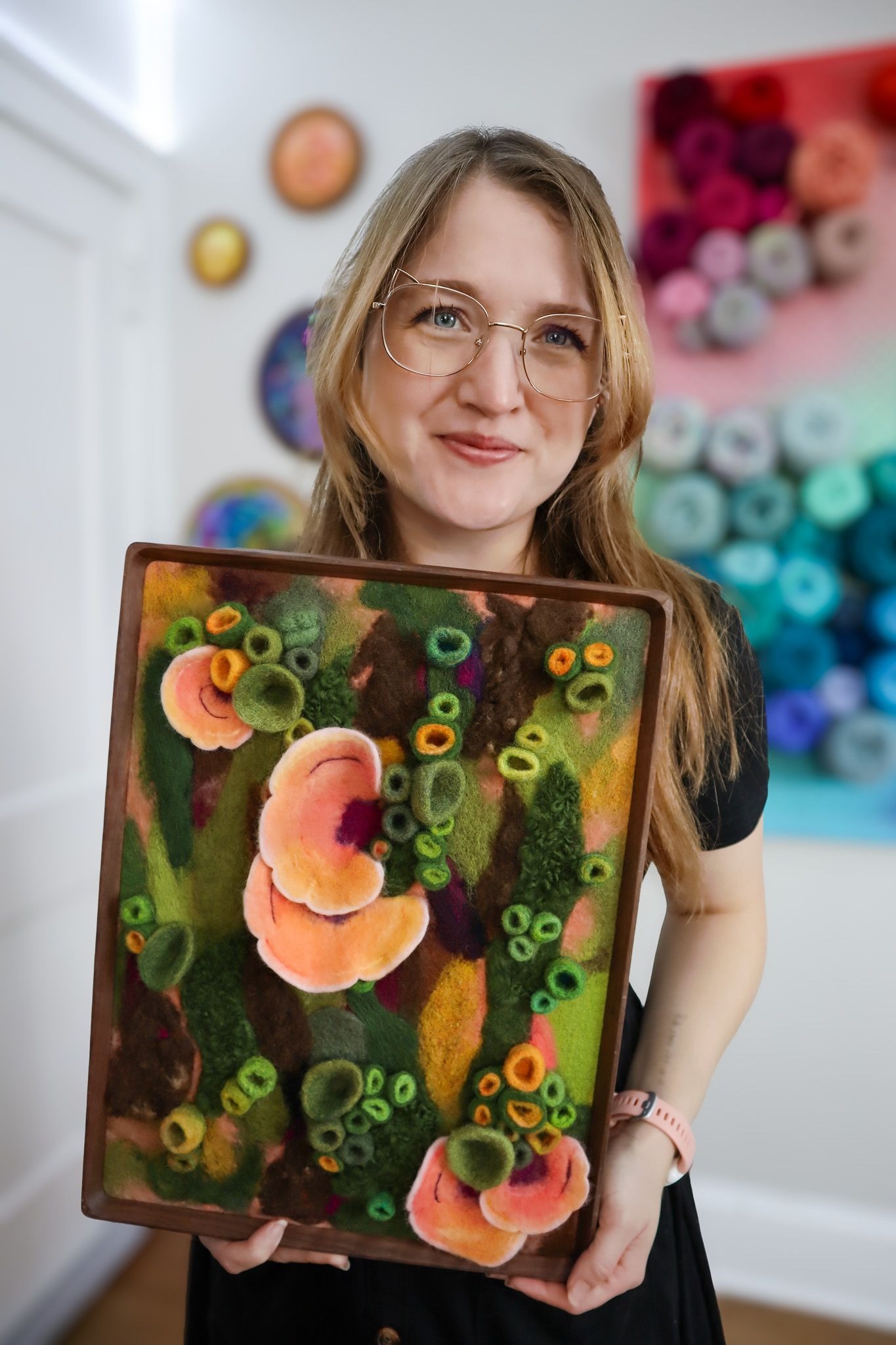
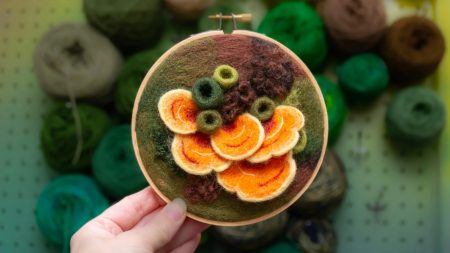
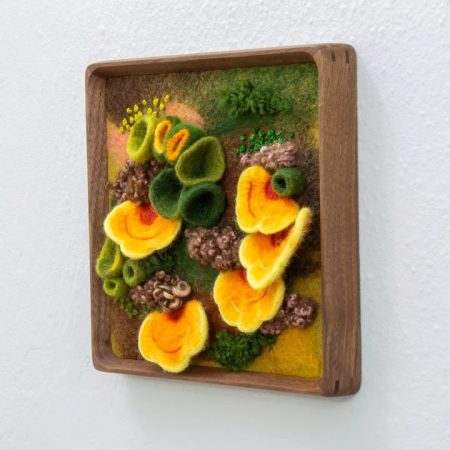
With most of my pieces, I don’t have a specific thing in mind. People will walk up to my work and see one of my mushrooms and go, is it this specific type of mushroom? And I’m like, yes. It is the one that you. It’s all of them and none of them. I don’t ever want to exclude or tell someone, no, the way that you found connection and entry into my art is wrong. If you found connection with my work, it is immediately correct. But it’s taken me a while to get to that mindset.
 JW: What advice would you give to young artists?
 AR: Don’t be too precious about your work. Art is so emotional and personal, and that is incredibly important. However, when you decide you want art to be your business, you have to sell your soul to capitalism a little bit and you can’t be too precious about your work. I wish that we lived in a society where we could just make art for the sake of making art. We don’t… We live under capitalism unfortunately. But you get to decide what success looks like for you. If success for you as an artist is you work a day job that is boring but pays your bills, but you get to make the art that you want at night, you’re succeeding. But if you want to sell your work and make your living from your art, you need to figure out how to do that. Any version of yourself where you are making art and you are happy about it, I think counts a success.
I wish I had been told in college that I get to choose what success looks like. Also, take a business class, or three, or read some books. Know what a profit in law statement is, because if you do want to sell your work, you need to have a really good handle on your numbers. There’s this whole idea of starving artist, or artists aren’t good at math, but I think that’s dumb. I know many artists who are exceptional business people, who are self sufficient and accomplished, and not starving. I feel like the starving artist myth is a way we can devalue art. If you don’t bleed for it, it doesn’t count? I don’t believe that. I am already in an art field that is devalued because it is historically women’s work. It is seen as decorative and silly, but why do you like that painting?
You need to be willing to try new things. And your definition of success can change. If you want art to be a business, you have to treat it like a business. And you have to have other hobbies. Art is my identity, it is integral to how I perceive myself and how I interact with the world. When I lost my ability to make art for a while after the hurricane… my joy, meaning, and identity just got eaten by mud. If art is all consuming, and something happens, then what’s left? It’s really hard to put yourself back together.
JW: What’s next for you? Is anything exciting coming up? Is there anything else you’d like to share?
AR: A couple of artists and myself are doing a show in Dalton, Georgia. This was originally supposed to be a solo show for me, but all that work floated away. The wonderful gallery there pitched back and was like, would you like to invite some Asheville friends who also lost work? So it’s myself and three other artists. It helps a lot to have things to look forward to. I also teach classes monthly, and I teach online. Go see the River Arts District, Trackside is open again. We were the first ones with significant damage that reopened. I’ve experienced the recent economic and political volatility directing impacting my sales and workshop registrations, and as a small business artist that’s scary. If you stop making art and stop making meaning, what are we fighting to preserve? Joy in a time where you’re only supposed to be scared is resistance. Making joy, finding meaning, resting… it’s all resistance. Making art is important because there needs to be something worth preserving, and joy is resistance. Every day I choose to find something that is joyful, I fight.
👉 Visit Amy Reader at Trackside StudiosStop by Amy’s studio at Trackside Studios in Asheville’s River Arts District to see her latest work. After losing much of her art in Hurricane Helene, she’s steadily rebuilding—creating new pieces, teaching workshops, and staying committed to making art.
Plan your visit and discover art around every corner.