“The River Arts District is so special… nowhere else have I experienced a place where you can walk around for days just talking to artists.”
-Jacob Krueger
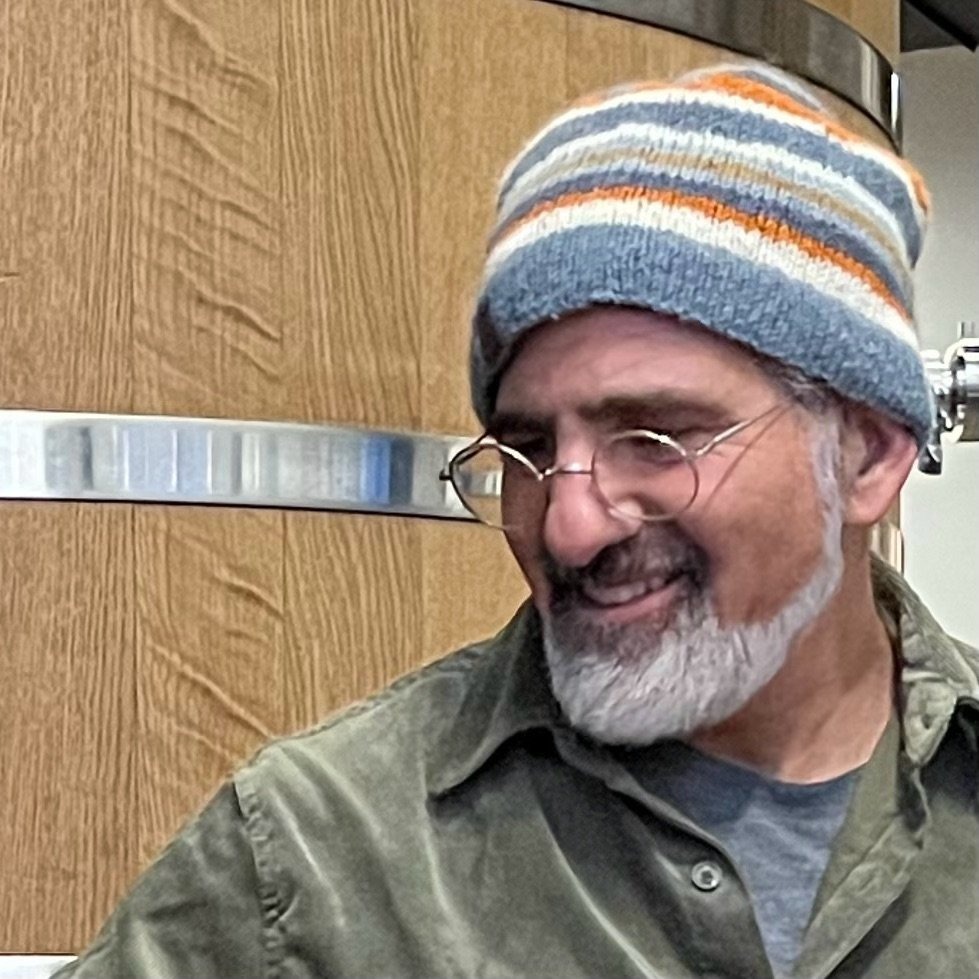
“Artist Spotlight” is a blog interview series featuring conversations by guest interviewer, Juliette Malowany, with working artists from Asheville’s vibrant River Arts District. Discover the people, creative processes, and studio spaces that make this hub of Asheville art scene a must-visit destination for art lovers and collectors.
Juliette Malowany: How long have you been at the River Arts District, and what brought you to Asheville?
Jacob Krueger: I’ve only been here since June. I went through a breakup in February 2022, sold everything I owned, and sold my house in Connecticut. For the first time in my life I didn’t know where I wanted to live… I had been in New York City for about 17 years, but my dog is not built for New York City. So I just started driving. Ashville was actually the first place I came. I was driving through Charlotte and there was an old friend who I hadn’t seen for like 15 years, and I was like, I’m pretty sure he lives in Charlotte. So I called him up and I was like, “What are you doing right now?” We got together for lunch and he was like, you need to go to Asheville. So I came to Asheville and I stayed here for a short period of time, but I was still very much on the search for the right place for me. I kept driving, and I basically drove around the country for about two and a half years.. Ultimately I was like, I think I’m gonna come back to Asheville.
JM: So out of everywhere in the US that you visited for two and a half years, you chose Asheville?
JK: I chose Asheville.
JM: What is unique about Asheville?
JK: The River Arts District is so special.. there is no nowhere like it that I’ve experienced. I just loved the idea that you could walk around for days just talking to artists and seeing where they’re making stuff, and having everything in the same location. I thought was just really amazing and I wanted to be part of that community and part of that conversation.
JM: How has living in Asheville and being a part of the River Arts District influenced you as an artist?
JK: I don’t know if I could say how it’s influenced me. My work is more about what’s happening inside than what’s happening outside, and obviously the inside and the outside affect each other. I show at Trackside Studios, I think there are about 60 artists there. Just being around other people’s work, and seeing what other people are doing is obviously inspiring, and it makes you go, oh, I love what they did with that. I want to try something like that, but use it like this.
JM: I know that you show work at Trackside, how has the hurricane impacted you and your art making?
JK: I got so lucky. My studio is downtown, so my studio wasn’t damaged. Trackside got absolutely devastated, and everybody on the first floor lost everything. I was extremely lucky I was on the second floor. I was so lucky that the hurricane didn’t affect me at all.
JM: How did you first get into visual arts?
JK: I had always written, but I never had any experience at all in the visual arts. I had a tiny bit of experience in theater in high school, and I wrote poetry, but I did not see myself as an artist. I was going to go to Dartmouth to study government, and I thought maybe I’ll be a political speech writer. Then two things happened. I started taking government classes and realized that I didn’t like them. Government classes were not about how to govern or how to help people, they were about how to get elected and how to stay elected. I found that really depressing. I realized I didn’t want to do this, and it occurred to me that as a political speech writer I would have to write speeches for people I didn’t believe in, saying things I didn’t believe in. Once I realized that that was the job, I was like, I’m not gonna do that job. The second thing that happened was I fell in love with a costume designer. She’s really the person who taught me that I could be an artist… and taught me to see myself as an artist, and taught me to see the world as an artist.

So I didn’t know what I wanted to do for the first time in my life. So I started taking other classes. I talked my way into a product design class… I basically went to the professor and said, “I know nothing about math, I know nothing about engineering. I have no skills for building anything, but I’m a really good problem solver.” And he was like, okay, you’re in. And I fell in love with product design. So I was trying to get an internship in product design, but I couldn’t get hired. They didn’t care what my GPA was, they didn’t care where I went to school. All they cared about was, can you draw? And I was like, no, I can’t frickin draw, but I can get your coffee and I can make your copies and I can learn. And they were like, nope, if you can’t draw, forget it. So I was like screw you, I’m going to learn how to draw.
So I started taking classes in the studio art department. My teachers really didn’t like me very much. They couldn’t give me a bad grade because I was working too hard, but most people who take studio art classes at Dartmouth have been drawing since they were two years old.. I had no physical dexterity. The professors just didn’t know what to do with me. They didn’t know how to help me. I was gonna give up, and then I took a class with a woman named Esme Thompson. Esme came around after the first class and she was like, so who have you studied with? I literally laughed in her face. I was like, studied with? I can’t even draw a stick figure, what are you talking about? So she said come talk to me after class. So, I went and talked to her after class and she was like, do you want to go to art school? And I was like no, I want to be a product designer. And she was like, no, I don’t think you understand what I’m offering. I’m offering to help you get into art school. I had no urge to get into art school, but I kept studying with her. She’s really the person who taught me how to see as an artist. She taught me how to draw, although not in the way that a product designer draws, but she taught me how to see and how to draw through my own eyes and how to start developing that physical dexterity. How to process the world as an artist. She was a huge, huge, huge influence on me, and really changed the entire trajectory of my life. I think she still hasn’t forgiven me for not going to art school. She told me, there’s a set design professor coming to Dartmouth, and you absolutely have to study with him, he’s a genius. So he became my second mentor in the art world.
On the very first day of class, we were making a scale model theater out of black foam core, pin pushes, and electricians tape. So I’m doing this, and the professor comes over to me and he snatches the electrician’s tape out of my hand, and he says, “You need to learn to think more broadly. This is not tape, this is mountains, this is this, this is that…” and then he threw it back on me. It was another amazing lesson for me, which is, art is happening all the time. You need to think as an artist all the time.
Even when you’re just making the scale model theater, doesn’t mean you’re not thinking as an artist. You need to learn to think more broadly. That was another formative lesson to me as an artist. Everything is an opportunity for creativity. So I thought, maybe I’m going to be a set designer. I was getting close to graduation, and I was still madly in love, and I thought we were gonna get married and stay together forever. My girlfriend really wanted to go to LA for costume design, but I really wanted to go to New York City and direct theater. So we talked about it, and she decided to get me an internship in LA. So the deal was I would go to LA and if I hated it, then she would come to New York with me. I accidentally sold a script as an intern. It’s a long story, and my payment was a Walkman. They basically created a job for me that doesn’t exist in the industry as an in house writer. So I didn’t take the traditional route, I was just in this weird creative role. They would hire a professional writer to write the story, and then they would screw it up, and then they would send the script to my office, and it was my job to make the story good. I worked on dozens of movies and limited series that I have no credit on.
While I was in LA, I was missing drawing, so i started taking drawing classes at UCLA extension. There was this unbelievable teacher there. Joe was such an incredible teacher, and not just an influence on me as an artist, but an influence on me as a teacher. Joe didn’t teach you what to do. He would come over to your drawing and he would at this point at an area and say, just look at this area right here. And you’d be like, okay, cool. And then he’d come back and go, just look at that area right there. And I’d be like, well, I just did, right? And then he’d come back and say look at that same area. It was incredibly frustrating. And then suddenly, oh my god I see it. He had this really gentle hand and he trusted you to figure out the answers yourself. Joe knew how to teach, other professors were teaching all the rules of art. It’s not about knowing the rules, it’s about learning how to see, how to feel, how to express yourself, and learning how to question. I took the same class over and over again for years.
Finally, Joe invited me to his advanced painting class. I was like, Joe, I can’t paint. I didn’t know how to paint. I didn’t even visualize or dream in color. He gave me the most valuable advice I ever had as a painter. He said, just always mix a color with another color before you put it on your canvas. That’s the only thing you need to know. If you know that, you’ll learn all the craft, you’ll learn everything else, just by doing that. It was another one of those incredible lessons. It’s not about being an expert. Your craft grows with time. It’s this lesson I keep learning again and again that, you can be a master of every aspect of your craft, and your art can still be boring. If you focus on what you see, react with what’s in front of you, you’re playing, and looking at things very deeply, you can have very little craft and still make very compelling art.
JM: What is the relationship between your screenwriting and your art?
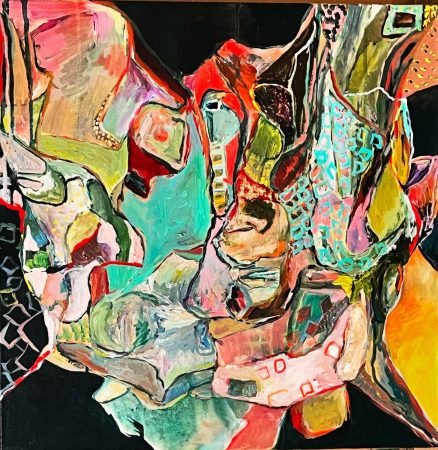
JK: I think there is an overlap. My art is very much about fragmentation. I start, if I can, with a model, sometimes I start with myself. Sometimes I start just throwing paint on a canvas, if I don’t have a model or a mirror. And then I will start to see a face. And a face inside the face. And another face inside of that face. My art is about this fragmentation. This idea that you can’t fully see a person, and you can’t even fully see yourself. We have all these different personas inside of ourselves. We are trying to be seen, but we don’t even know exactly who we are. We are trying to see, but you can only see the piece of the person that’s in front of you in that moment. I talk about it like Cubism of the internal landscape. That’s me putting thought onto something that’s mostly visceral. But there’s an interesting parallel with my writing. I got really obsessed with telling a story that has two main characters, and they’re both the good guy, but they are on opposite sides of the same war. I’m interested in that place, how people are similar when they seem so different, and our traditional notions of good or bad, right or wrong. They’re connected to that same problem of identity. How can two people who both feel justified end up at war? So there’s a similarity there between my art and my writing. I recently decided to write a novel. I have a long way to go, but I thought, wouldn’t it be interesting to write a novel that felt like my paintings? I’m playing around with a very non linear structure, and I’m calling it a fictional memoir. Everything that happens is emotionally true, even though it’s not literally what happened. The love interest character, her name keeps changing in different scenes. It’s about how we project ourselves onto our partners. Those themes tend to weave through, there’s a dialogue between them.
JM: It sounds like you have a lot of different types of creative projects going at the same time, all kind of speak to each other, but more ultimately are speaking to you.
JK: It’s always about what you’re going through at the moment, even when you’re not aware of it, even when you’re just throwing paint at a canvas. In screenwriting, you’re always looking for an answer. You’re trying to reach this place of catharsis. Movies have this arc where you build towards some kind of answer. Painting for me are more about asking questions. They don’t have to have an answer, it can be more like, “what does it feel like”? It always feels more like a search for me.
JM: So when do you feel like a painting is done?
JK: Well by god, I have no idea. Sometimes you just know. So generally the process for me is I’ll start painting, and then I’ll start turning the painting, and make a new painting, and turn it again, and make a new painting. I like to turn them because it breaks you out of that desire to finish, desire to control.
That was something else I learned from Joe. Joe was obsessed with obliterating his own work. He would paint a masterpiece, and then take the biggest, widest roller he had and then paint over it with house paint. And then he’d do another masterpiece, and paint over it. Over and over, until there was just pieces of the other paintings left. He was poking fun at himself. It taught me a kind of fearlessness. He wouldn’t let us paint on canvas, he said if you paint on canvas you’re going to think you’re an artist, and you’re going to get precious with it… paint on paper, so you can feel like you can throw it away. It was such a great lesson, it’s why I turn the canvas. You get something that’s good, but it’s not the greatest painting you’ve ever made. You don’t want to destroy it because it’s good, but it’s not incredible. If you just take the painting and turn it, you’re going to destroy it, and then you realize that doesn’t matter. You’re gonna find something else and you’re gonna make that beautiful, and you’re gonna kind of keep doing that until you realize, this is where the painting lives, this is really what it’s about. I kind of know a painting is done when your eye knows what to look at, when there’s a desire to keep looking and keep discovering new things. If there’s not that one thing you see first, then the painting’s not done. It has to call you. In my work, there’s always a lot of complications, I like there to be a lot more to discover. Often I don’t know it’s done, so I’ll take a picture at every stage.
JM: How long does a painting typically take you?
JK: It really depends. Sometimes it’s like 3 hours and it’s done. Sometimes it takes years. I have one I started in like 2005, and it kind of sat there, because it was beautiful, but it wasn’t complete. I didn’t know what to do with it. You know if you add one more stroke to it, you’re gonna mess it up. You have to be willing to lose it. My point of view now is like, if it’s not one of the best paintings I’ve ever done, it’s not done. I have so many of them, so why hold on to paintings that are not your best? Even if it’s beautiful, is it one of the best things I’ve ever done?
JM: It sounds like your process is very intuitive and all about challenging yourself.
JK: There’s very little intellect, which is the opposite of writing. Writing is also very intuitive. It’s usually not taught very well, so people are taught the opposite, and that’s the same as art school. People lose their voices in art school, unless they have really good teachers. The same thing happens to screenwriters. You’re taught all this craft, you’re doing something accurately, but there’s nothing of you in it. Letting go of the need for perfection in craft and following your intuition… you’re going to create something interesting. Also learning how to get rid of judgement, especially new artists and writers. If you ask a new writer to show you their best scene, it will be their most boring. If you ask them to show you their worst scene, it’ll be their most exciting scene. Because the exciting scene doesn’t feel like anybody else’s writing. It has their voice, and so it makes them feel anxious, because they feel seen. When you’re teaching screenwriting, you have to teach a balance between the art and the craft. There has to be a dance where there’s just the right amount of pressure between the two.
JM: What advice would you give you young/aspiring artists?
JK: I have a lot of advice. The most important thing is you want one cook in your kitchen, Everybody needs mentorship, but you only need one. Too many people end up with 10 people.. That just dilutes everything. Group critiques are even worse – whoever has the most charisma ends up dominating the way the group talks about your work. When you’re looking for mentorship, if the person is telling you exactly what to do and exactly how you should do it, you don’t have a good mentor. If they’re giving you a ton of advice and you’re not actually doing a lot of the talking, you have bad mentorship. Whereas if the person’s going, hey, look at that area.. or if the person’s asking you questions, that’s good mentorship. You want to find that one person you trust, and it doesn’t matter what anybody else says because people are going to hate your work no matter what. You could paint the Mona Lisa and somebody would say, “it’s not clear what she’s thinking, and I don’t like the way her eyes follow you.”
It’s about going, I trust this person. And everybody else is just noise. Remembering it’s more about voice than craft, and craft will come. It’s also about, how do I allow myself to get past my own judgement and stop thinking about if it’s good or bad. It’s almost like a good parent would say to their child. You don’t say to your child, “you’re gonna be a lawyer and you’re gonna date the opposite sex”, right? My belief of a good parent is saying, I wonder what you are. Instead of asking if it’s good or bad, I’m going to ask, what is it? What does it want to be? That’s actually way more important than your plan.
You also have to build a practice. With all art, art isn’t about the days when the muse is with you. If that’s what art was, everybody would be an artist. Art is about the days you don’t want to do it, you don’t feel inspired, you feel stuck, you feel like you have no talent, and you think you should have probably gone to law school. Those are the days where real artists really make. They don’t do it by showing up and painting or writing well, they do it by showing up and going, I might write really badly today, but I’m gonna put in my time. Building that dependable schedule, like, I am always in the studio at this time and I don’t leave until this time. Having multiple small sessions is better than one big one, because you want to build that rhythm, that pattern, that desire for more.
Also, you need a day job. At least I do, the way I’m built. I needed a day job that supported my art, used my brain in a different way, and allowed enough energy and schedule flexibility for me to do my art. When I started, I actually had the wrong idea, which was like, “I’m going to make millions of dollars writing scripts.” I had a nice career as a screenwriter, but I didn’t make that kind of money. It also made me unhappy, because I wasn’t pursuing screenwriting as an art at that time, I was pursuing it as a means to an end.
Think of it instead like, don’t put off your dream, but do support your dream. What’s the job that actually supports your art, and how do you build that sustainably, and make sure it’s a job you like? It takes luck to make it in any art field, and you don’t know if your luck is going to happen tomorrow or in 20 years. So you have to have a day job that supports your work that you love, otherwise you’re going to burn out and end up too broke and quitting, or miserable and quitting.
👉 See Jacob’s work in person at Trackside Studios
View Jacob’s work at Trackside Studios, where his evolving portraits explore identity through fragmentation and layered perspective.