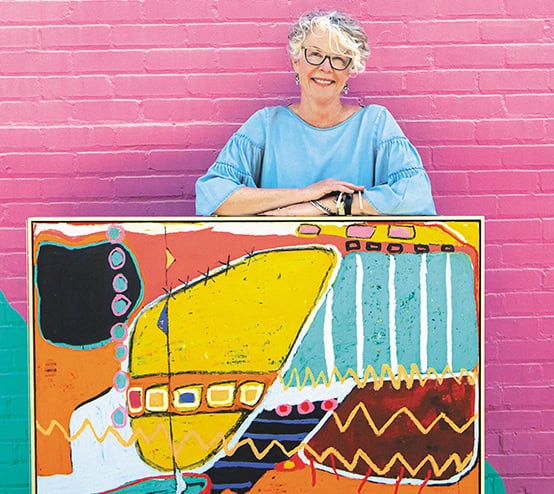
“[The RAD is] one of the few places that artists can have studio space and gallery space. For some artists, it’s the only retail outlet for their work.”
-Cindy Walton
Juliette Malowany: How long have you been at the River Arts District?
Cindy Walton: I would say 12 years, maybe 13. I painted out of my home when I first got out of school at UNCA.
JM: How did you first hear of the River Arts District?
CW: Golly, if you were UNCA and then half the students have.. it’s unavoidable. I had two friends, they had the space that is now the Wedge Brewery. My husband and I moved here in ‘88, and I did a lot of volunteer work with the art museum. When I got involved with UNCA I heard about the district.
JM: So you’ve been in Asheville for quite some time now. What inspired you to move to Asheville?
CW: I met my husband, we were married in ‘81, and he got a job offer up here in Asheville. I was not a practicing artist at the time, and I decided to be a stay at home mom. I started meeting people that were involved in the arts, like Tucker Cook, who said “you really need to think about painting”. And that’s the way it started.
JM: What’s something you think is unique about the River Arts District?
CW: It’s one of the few places that artists can have studio space and gallery space. For some artists, it’s the only retail outlet for their work. So many artists are not in control of the sales of our work, and having to pay 50% or 60% commission is a lot.
JM: How has living in Asheville and being part of the River Arts District influenced you as an artist?
CW: Living in Asheville gave me the opportunity to go back to school… and when you’re in your late 30s, early 40s, you make a decision on that commitment. It also pushed me to not be a representational regional painter; landscape painter. By going back to school and seeing the bigger world of art through university and travel, I realized there’s a lot more than just that. I use landscape influences in a lot of my work, and as I’ve gotten older I’ve seen a lot of my Asheville influence. I think it’s one of the few places in the Southeast that you have that kind of vibe.
JM: What kind of vibe do you mean?
CW: I don’t know how to say it. In our own way, we are a little more cosmopolitan. You’ve got graffiti over there, and you go around the corner and there’s a coffee shop or fine dining next door. It’s that kind of city, kind of like New York is. I call this work “around the corner” and it comes from that kind of feel. Asheville is not a typical southern town. There’s bright colors, there’s music.
JM: How has the River Arts District changed since you’ve been here and where do you see it going in the future?
CW: As of last summer, there were a lot of changes. With the greenway, I felt like it was becoming more gentrified. I was concerned for younger artists finding space. Now with Helene, it’s really changed the dynamic. I feel like we’ve kind of back tracked 10 or 15 years in terms of development. I’m just not sure what’s going to happen. We were becoming a destination for art. We’ll see.
JM: I did want to speak to you about the hurricane. In your art, you talk about construction and deconstruction in your art, particularly with your series “Constructs”.
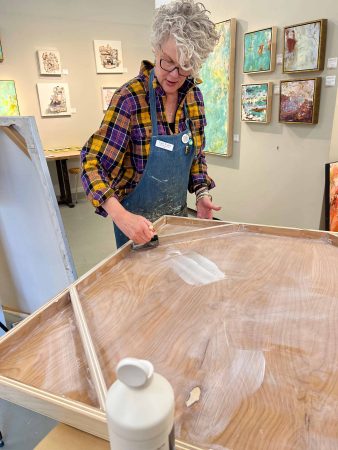
CW: That series came out of COVID times. I did a lot of those pieces while I was working from home. Those are really hard to make physically, I damaged my hand during that. The way I was working was not good, I had to have surgery on my hand. Originally, I had a lot of paintings on paper. I ripped them up into strips and wove them together. Then I started ripping them more and adding cardboard. The original couple were really flat, they didn’t go three dimensional at first. I started incorporating collaging and sewing too. It was about material, and how the light casted. Trying to make it here was hard for me, with people watching and looking at me, like, what are you doing? Tearing and gluing things. I still like them, they are near and dear to my heart. I might do another series on paper. Just do it a little differently, but I’d have to ponder that one. As I went along, I was painting still, but I was a different person. The more deconstructed pieces answer back to something I did a long time ago, but they seem to resonate better now.
JM: Do you think the hurricane has impacted your art making? We’ve been witnessing a lot of construction and deconstruction, especially in regards to nature.
CW: I don’t know because I didn’t personally go through that. I find that it takes things a while to percolate through me. I didn’t want to work for weeks [after the hurricane]. But I can say my work was not impacted as much as other people.
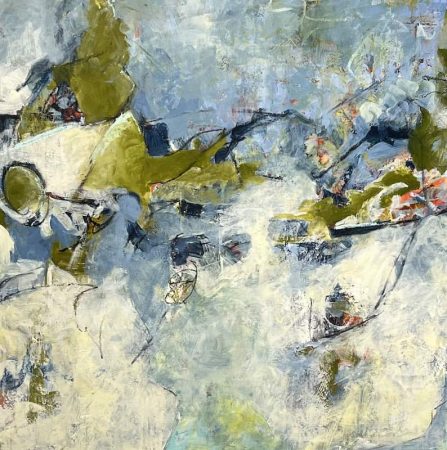
JM: Do you find that one body of work sells better than the other?
CW: These – they are more nature based. So I keep dropping back to that. It took me a long time to stumble into this. I can still work with some things that I’m thinking about, and then have something I can sell that will fund me. A lot of artists don’t feel that way, they’re purists. But I needed to pay for my habit, I don’t have another job. You just have to mix it up. It’s hard to make the same thing all the time.
JM: How intuitive is your art-making practice?
CW: It’s not planned. I just put stuff down, and then I go “oh god no, I’ve got to change that.” When I was in school, it was more planned. I was working from photographs. There’s a lot of people who do beautiful representational work, it’s just not my thing. Sometimes I feel it’s more an emotional expression of place and time, where I am in my walk of life.
JM: How do you think about color in your work?
CW: I think color plays a lot in my work. I’ll find a color, and then I want to expand out from that color. Those three were all about getting warm colors together.
JM: How long does a piece typically take you?
CW: The medium that I’m working with has no drying agents, so it takes a really long time. And I keep changing my mind, so I go over it again, etc. These pieces take weeks. Weeks and weeks. If I start adding linseed I can slow down my drying time.
JM: What advice would you give young artists?
CW: Around middle school, everybody gets a little afraid of expressing themselves. If it doesn’t look right, they just throw in the towel. And I found if we keep moving on, even just a little bit all the time, you’re going to improve. If somebody really wants to make art, you just keep making. I teach a lot of adults now, and they tell me my work looks so easy. It’s 30 years experience, and I work at it everyday. It’s like piano or guitar, if you don’t practice you’re not going to improve. When I talk to younger people, whatever their age, I tell them consistency is key. You have to do it.
👉 Visit Cindy Walton at Pink Dog Creative, 348 Depot St, Asheville, NC.
Cindy’s studio is open Thursday-Saturday 11-4 or by appointment. While you’re there, take time to wander the River Arts District where former warehouses now house over 200 working artists, colorful murals greet you at every turn, and creativity spills out onto the sidewalks.
Plan your visit and discover art around every corner.